
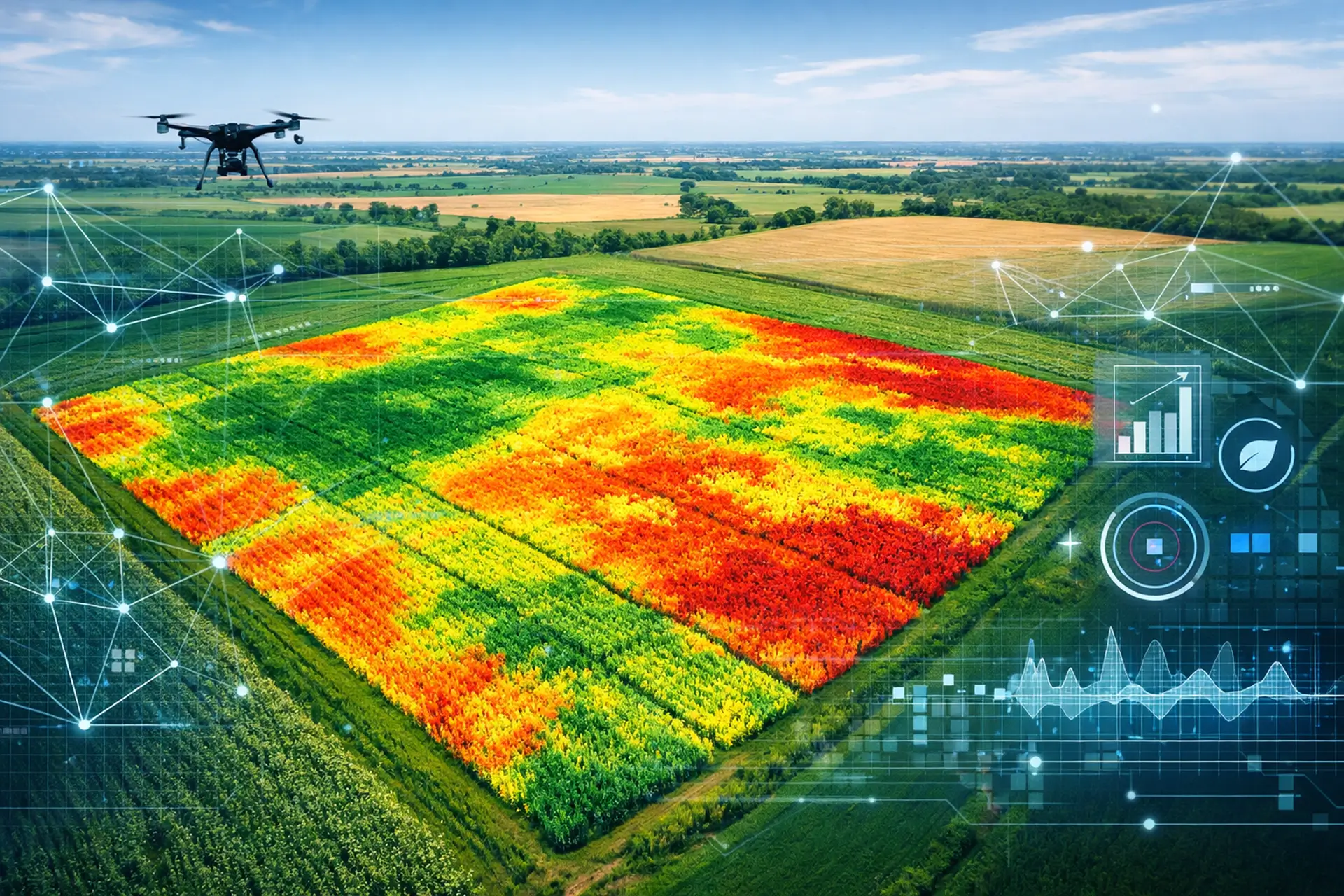
From fixed schedules to predictive models
For decades, plant nutrition has been based on preset calendars, occasional soil analyses, and general crop recommendations. This model, although effective in its time, reflects reactive rather than predictive agriculture. However, the arrival of Agriculture 4.0 is radically transforming this logic.
Artificial Intelligence (AI) applied to plant nutrition allows fertilization to be adjusted according to dynamic variables such as climate, soil texture, microbiology, phenological stage, water stress, and historical yield data.
The transition is clear: from fixed schedules to predictive algorithms. This transformation redefines precision fertilization.
Agriculture 4.0 and the new agronomic paradigm
Agriculture 4.0 integrates technologies such as:
- IoT sensors in soil and crops
- Agronomic Big Data
- Machine-learning-based predictive models
- Multispectral satellite imagery
- Automated recommendation systems
The goal is not simply to digitize the field, but to optimize agronomic decisions in real time.
In this context, plant nutrition becomes a dynamic system in which every nutrient application decision can be precisely adjusted.
What Artificial Intelligence really brings
1. Predictive modeling of nutritional needs
Algorithms can analyze yield histories, correlate climate with nutrient uptake, detect deficiency patterns, and anticipate demand peaks. This makes it possible to design fertilization strategies adapted to each plot.
2. Real-time data integration
Sensors measuring moisture, electrical conductivity, pH, and temperature continuously feed predictive models, enabling:
- Immediate fertigation adjustments
- Nutritional corrections before visible deficiencies appear
- Optimization of nutrient uptake
3. Reduction of losses through leaching and volatilization
AI analyzes variables such as rainfall forecasts, soil retention capacity, and uptake curves by phenological stage, reducing nutrient losses and environmental impact.
Machine Learning and crop-specific uptake curves
Each crop has different uptake curves, and within the same crop, variety, soil, and climate alter its behavior. Machine learning allows applications to be personalized and micronutrients to be recommended at critical moments.
Precision agriculture and variable fertilization
The combination of NDVI maps, multispectral imagery, and geolocation enables variable-rate fertilization within the same farm, optimizing uniformity, efficiency, and profitability.
Economic impact of AI
Studies show:
- 10–25% reduction in fertilizers
- 5–15% yield increase
- Improved nitrogen-use efficiency
Sustainability and regulatory compliance
AI facilitates nutritional traceability and technical justification, helping meet regulations and reduce environmental impact.
The role of soil
Integrating microbiology, organic matter, C/N ratio, and enzymatic activity allows for more accurate models and opens the path toward microbiologically intelligent nutrition.
AI does not replace technical judgment
It processes data, detects patterns, and suggests scenarios, but the final decision remains human.
Implementation challenges
Initial cost, training, platform integration, and data quality are current challenges.
The future: autonomous plant nutrition
We will soon see autonomous fertigation systems, adjustments based on climate predictions, and models combining biotechnology and AI.
Conclusion
AI in plant nutrition is not a trend; it is a natural evolution. We are moving from general applications and rigid calendars to predictive models and variable fertilization. The question is no longer whether it will arrive, but who will integrate it first.