
Agrovisión — magazine of agricultural innovation by Excellent Nutrients
The Soil Microbiome: The Invisible Ecosystem That Governs Agricultural Productivity
Beneath every hectare of agricultural soil live more than 10 billion microorganisms per gram of earth. Bacteria, fungi, actinomycetes, protozoa, nematodes and archaea form a biological network of extraordinary complexity. Indeed, this network regulates nutrient cycles, soil physical structure and the root health of crops.
For decades, conventional agronomy ignored this biological dimension. Soils were treated as chemical substrates, managed exclusively through mineral fertilisation. As a result, the soil microbiome has suffered progressive degradation that today compromises the productivity of millions of agricultural hectares worldwide.
However, soil microbiology has emerged as one of the most dynamic disciplines in agronomic science. Furthermore, its practical application in fertilisation programmes remains limited in most conventional farming operations. Therefore, understanding how the soil microbiome functions is an essential competence for any agricultural technician aiming to maximise sustainable productive efficiency.
Composition and Functions of the Soil Microbiome
The soil microbiome is not a homogeneous mass of microorganisms. Moreover, it is an ecosystem structured into functional communities with specific and complementary roles.
Nitrogen-fixing bacteria: Genera such as Rhizobium, Azospirillum and Azotobacter capture atmospheric nitrogen and convert it into plant-assimilable forms. In soils with active bacterial communities, biological nitrogen fixation can contribute between 20 and 200 kg N/ha per season. Additionally, Azospirillum produces auxins and gibberellins that directly stimulate root growth.
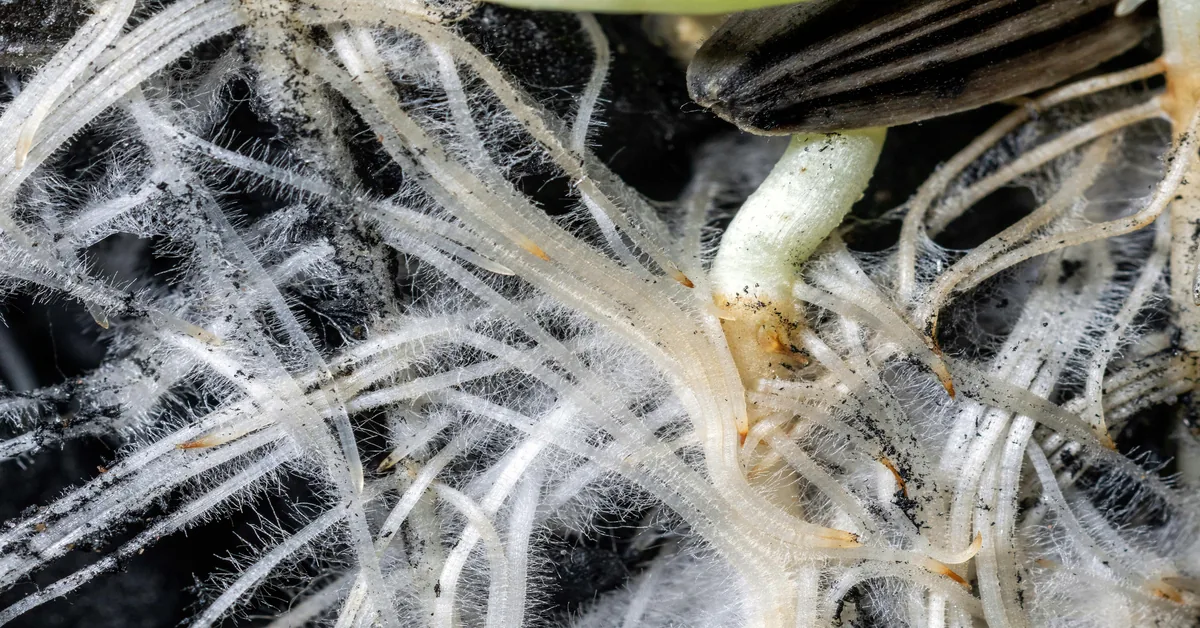
Arbuscular mycorrhizal fungi (AMF): Fungi of the genera Glomus, Rhizophagus and Funneliformis establish symbiosis with plant roots. This association expands the root absorption surface up to 700 times, improving the uptake of phosphorus, zinc and water under stress conditions. Consequently, AMF also produce glomalin, a glycoprotein that cements soil aggregates and stabilises organic carbon.
Phosphate-solubilising bacteria: Genera such as Bacillus, Pseudomonas and Penicillium produce organic acids that solubilise inorganic phosphorus fixed in the soil. In soils with high solubilising activity, phosphorus availability can increase by 30 to 50% without additional fertiliser input.
Actinomycetes: Filamentous microorganisms, particularly of the genus Streptomyces, produce natural antibiotics and antifungal compounds that suppress soilborne pathogens such as Fusarium, Pythium and Rhizoctonia. Their abundant presence is a reliable indicator of high biological activity.
Humic substance-producing bacteria: Specific bacterial communities participate in nitrification and humification processes, converting fresh organic matter into stable humus fractions. Their activity determines the speed and efficiency of organic carbon stabilisation.
To optimise these processes, it is essential to apply advanced plant nutrition strategies.
Factors That Degrade the Soil Microbiome: The Silent Threats
The degradation of the soil microbiome is a slow and cumulative process. Its productive consequences are frequently invisible until they become severe. Nevertheless, the most documented degradation factors can be identified and addressed.
Excessive use of systemic fungicides: Broad-spectrum fungicides do not discriminate between pathogenic and beneficial mycorrhizal fungi. Repeated applications over several seasons can reduce soil fungal diversity by more than 60%, with a direct impact on phosphorus uptake and structural stability.
Excessive nitrogen fertilisation: High doses of ammoniacal or nitric nitrogen alter the microbial balance of the soil, favouring opportunistic short-cycle bacterial communities over stabilising fungal communities. As a result, the soil develops high mineralising activity but low humification capacity.
Intensive tillage: Deep ploughing destroys the hyphal networks of fungi that structure soil macroaggregates. A single mouldboard pass can eliminate up to 80% of active fungal biomass in the top 20 cm of the profile.
Compaction: Heavy machinery traffic reduces macroporosity and limits gas exchange. Furthermore, this creates anaerobic conditions that favour low-efficiency microbial communities.
Absence of organic matter: Without an energy substrate, the microbiota cannot remain active. Consequently, soils with less than 1% organic carbon have such reduced microbial activity that nutrient cycles slow significantly.
How to Evaluate Soil Biological Health
Evaluating soil biological health requires specific indicators that go beyond conventional chemical analysis. Indeed, the most widely used in modern agronomy provide a comprehensive picture of microbial activity.
Microbial biomass: This measures the total carbon and nitrogen contained in living soil microorganisms, expressed in mg C/kg soil. Values above 300 mg C/kg indicate an active and diverse microbial community.
Basal soil respiration: This measures the CO2 released by the microbiota under standard laboratory conditions. Moreover, its ratio with microbial biomass, the metabolic quotient, allows evaluation of the energy efficiency of the microbial ecosystem.
Enzymatic activities: Soil enzymes such as dehydrogenases, urease, phosphatase and betaglucosidase reflect the functional capacity of the soil to mineralise nutrients. Phosphatase activity is particularly relevant in Mediterranean calcareous soils.
Metagenomic sequencing (NGS): This is the most advanced technology for characterising the soil microbiome. It identifies and quantifies all microorganisms in a soil sample through massive environmental DNA sequencing, detecting imbalances in functional communities with precision impossible using conventional methods.
Strategies to Regenerate the Soil Microbiome
Regenerating the soil microbiome requires time, consistency and a combination of complementary practices. However, no single input regenerates the microbial ecosystem in isolation.
Inoculation with next-generation biofertilisers: The application of formulated microbial consortia is the most direct strategy for reintroducing microbial diversity into degraded soils. These consortia combine nitrogen-fixing bacteria, mycorrhizal fungi, phosphate solubilisers and phytohormone producers. Furthermore, next-generation biofertilisers use encapsulation technologies that significantly improve the survival of inoculated microorganisms.
Compost extracts and compost tea: Liquid extracts of mature compost contain active microbial communities and humic precursors that immediately stimulate soil biological activity. Additionally, their application through fertigation distributes the microbial load homogeneously throughout the root profile.
Reduction or elimination of tillage: The transition towards minimum tillage or no-till systems has the greatest impact on the conservation of soil fungal networks. In soils with more than 5 years of no-till, fungal biomass can be 2 to 4 times higher than in equivalent tilled soils.
Crop rotation diversification: The diversity of root exudates generated by different plant species is the main driver of soil microbial diversity. Rotations including legumes, cereals and cover crops generate a much richer exudate profile than monocultures. Consequently, they favour more diverse and functional microbial communities.
Application of humic and fulvic acids: Humic substances act as habitat and substrate for the soil microbiota. Their exogenous application creates the physicochemical conditions necessary for the establishment of inoculated microbial communities.
Soil Microbiome and Precision Plant Nutrition
The integration of soil microbiome management with precision plant nutrition programmes represents the most advanced paradigm in current agronomy. A soil with an active and diverse microbiome does not only mineralise nutrients. Moreover, it amplifies the efficiency of applied fertilisers, suppresses pathogens, improves physical structure and stimulates root development.
In practice, two farms with the same fertilisation programme can obtain radically different yields when their microbiomes differ significantly. Therefore, the microbiome acts as an efficiency multiplier for the nutritional programme.
The most advanced nutrition programmes already incorporate soil biological management as a central axis. The optimal sequence combines analytical microbiome evaluation, inoculation with specific consortia, application of humic substances as support, and mineral fertilisation calibrated according to estimated biological mineralisation potential.
This integration allows synthetic fertiliser doses to be reduced by 20 to 35% without compromising yields, with a direct impact on profitability and the environmental footprint of the farm. Learn more at excellentnutrients.com.
The Soil Microbiome and Climate Change: Resilience and Adaptation
Climate change is altering edaphoclimatic conditions in the main agricultural zones worldwide. Soil temperatures are rising, drought periods are lengthening, and intense rainfall events are becoming more frequent and unpredictable. In this context, the soil microbiome emerges as one of the most powerful resilience mechanisms of agroecosystems.
Microbial communities adapt continuously to environmental conditions, modulating their metabolic functions in response to changes in temperature, humidity and organic substrate availability. However, this adaptive capacity has limits. Degraded soil microbiomes with low diversity are much more vulnerable to climate disturbances than diverse and functionally redundant microbiomes.
Functional redundancy and microbial resilience:
Functional redundancy is a key concept in microbial ecology. When multiple species can perform the same metabolic function, the system is more resistant to the loss of any one of them. A diverse microbiome maintains its productive functions even when some populations are affected by climate stress. An impoverished microbiome, by contrast, can collapse functionally during a prolonged drought or heatwave.
Recent studies show that soil temperature increases of even 1 to 2°C above the historical mean can significantly accelerate organic matter mineralisation. As a result, this reduces organic carbon stocks and alters the balance between bacterial and fungal communities. Bacteria tend to dominate over fungi in thermally stressed soils, which reduces structural stability and long-term humification capacity.
Microorganisms tolerant to climate stress:
The selection of microbial consortia tolerant to thermal and water stress is one of the most documented adaptation strategies. Bacteria of the genus Bacillus and fungi of the genus Trichoderma maintain their functional activity across wider temperature ranges. Furthermore, these thermotolerant microorganisms continue mineralising nutrients and protecting roots even under severe stress conditions.
The incorporation of biochar as a soil amendment is another effective strategy. Biochar acts as a physical refuge for the microbiota, maintaining local humidity and stable temperature in its micropores. Additionally, it creates protected microhabitats where microbial communities can survive extreme drought or heat episodes.
Precision biofertilisation and climate adaptation:
The diversification of microbial inoculation programmes with species adapted to local and projected climatic conditions is the most advanced trend in precision biofertilisation. Moreover, adaptive inoculation programmes take into account regional climate projections to select strains with the highest probability of establishing under future conditions.
Investing in the diversity and resilience of the soil microbiome is consequently one of the most profitable strategic decisions a progressive farmer can make today, benefiting not only the current season but also the coming decades.
From Agrovisión, magazine of agricultural innovation by Excellent Nutrients, we will continue exploring how technology, science and innovation are redefining the future of modern agriculture.