
Agrovisión — magazine of agricultural innovation by Excellent Nutrients
Introduction: climate change redefines modern agriculture
Climate change is no longer a future threat. However, it is a reality that affects every crop cycle in the present.
Extreme temperatures, prolonged droughts and irregular rainfall disrupt traditional agricultural calendars. Therefore, farmers need new tools and approaches.
At Agrovisión, magazine of agricultural innovation by Excellent Nutrients, we analyze today the strategies that allow us to build resilient crops. Likewise, we review how advanced plant nutrition can make the difference.
Furthermore, this article gathers practical examples applicable to different types of farming operations. The central idea is to offer useful tools for the farmer’s daily work.
As a result, we will cover everything from soil management to the latest monitoring technology. Each section includes recommendations applicable from the next campaign.
On the other hand, we also include the most common mistakes that we observe in the field every season. Knowing them in advance helps avoid them before they affect the harvest.
What a resilient crop really means
A resilient crop is one capable of maintaining its productivity under adverse environmental conditions. As a result, it combines genetics, agronomic management and balanced nutrition.
Resilience does not depend on a single factor. On the contrary, it arises from the sum of decisions made throughout the entire production cycle.
Furthermore, a resilient crop recovers faster after a stress episode. This recovery capacity proves key in increasingly unstable climate scenarios.
Likewise, agronomic resilience does not mean the absence of stress. Rather, it means a faster and more efficient response to that stress.
Therefore, evaluating the resilience of a crop requires observing several consecutive production cycles. A single favorable year does not guarantee stability in the long term.
In this sense, many agronomic technicians already include resilience indicators in their annual reports. These indicators allow varieties and management practices to be compared objectively.
Water stress and drought: practical adaptation strategies
Water scarcity is one of the biggest challenges for agriculture today. However, there are practices that reduce its impact significantly.
First, precision irrigation allows the water supply to be adjusted to the real needs of the crop. This technique avoids both deficit and excess water.
Likewise, the use of mulching conserves soil moisture for longer. Therefore, it reduces the frequency of irrigation needed during critical periods.
Specific biostimulants also help plants tolerate drought better. As a result, they maintain photosynthetic activity even with less water availability.
On the other hand, scheduling irrigation according to crop evapotranspiration notably improves efficiency. This methodology reduces water consumption without affecting yield.
Furthermore, using moisture sensors at different soil depths provides very valuable information. This information allows the optimal irrigation moment to be anticipated.
Likewise, controlled deficit irrigation, applied during less sensitive crop phases, saves water without penalizing the harvest. This technique requires precise knowledge of crop phenology.
Heat stress: protecting crops from extreme heat
Heat waves cause flower abortion and reduced fruit set in many crops. However, some agronomic strategies mitigate these negative effects.
On the contrary, a well nourished crop tolerates temperature peaks better than one with deficiencies. As a result, preventive nutrition becomes a key tool.
Furthermore, partial shading and adequate ventilation reduce heat stress in protected crops. This combination of physical and nutritional management improves final results.
Micronutrients such as potassium strengthen the plant’s stomatal regulation. Likewise, this regulation proves essential for controlling water loss through transpiration.
As a result, applying potassium preventively before forecast heat peaks is highly recommended. This practice reinforces the plant’s natural resistance.
Likewise, irrigating during hours of lower sun exposure reduces thermal shock in the roots. This simple measure lowers the stress accumulated during the hottest days.
On the other hand, whitening nets or covers reduces direct radiation on the crop. This simple technique lowers leaf temperature by several degrees during central hours.
The role of biostimulants in plant resilience
Biostimulants act on the plant’s internal defense mechanisms. As a result, they improve its response capacity to abiotic stress situations.
Seaweed extracts, amino acids and humic acids stand out among the most widely used biostimulants. However, each one acts on different physiological processes.
Therefore, the appropriate combination of biostimulants must be adapted to the crop and to the phenological phase. This customization maximizes the results obtained in the field.
Furthermore, biostimulants reduce recovery time after adverse climate events. This advantage proves especially valuable in areas with changing weather patterns.
Likewise, some biostimulants activate genes related to osmotic stress tolerance. This molecular mechanism partly explains their agronomic effectiveness.
On the other hand, foliar application of biostimulants offers a faster response than root application. As a result, it proves useful during moments of sudden and intense stress.
It is also worth planning applications preventively, before announced climate events. This anticipation notably improves the effectiveness of the applied biostimulant.
Advanced plant nutrition programs for resilient crops
At Excellent Nutrients we develop advanced plant nutrition strategies adapted to each type of crop and climate scenario. Therefore, each program responds to specific needs.
These programs combine macronutrients, micronutrients and biostimulants in doses adjusted to the phenological cycle. Likewise, they consider the type of soil and the available irrigation system.
Balanced nutrition strengthens the cell wall and improves stress tolerance. As a result, plants respond better to heat or drought episodes.
On the contrary, unbalanced nutrition aggravates the negative effects of environmental stress. As a result, prior soil diagnosis proves essential before designing any program.
Furthermore, periodic analytical monitoring allows the nutrition program to be adjusted during the cycle itself. This flexibility marks the difference between a generic plan and a truly effective one.
Likewise, integrating calcium and silicon into the program strengthens cell structure against physical stress. This combination improves the mechanical resistance of stems and leaves.
It is also advisable to review the nutrition program every campaign based on the results obtained. This continuous review guarantees a progressive improvement of agronomic results.
Varietal selection and climate adapted genetics
Choosing varieties adapted to the local climate significantly reduces production risk. However, this decision must be combined with coherent agronomic management.
Short cycle varieties allow the periods of greatest climate stress to be avoided. Therefore, many farmers are adjusting their planting calendars.
Furthermore, genetic improvement programs increasingly incorporate drought and heat tolerance criteria. This trend will continue to shape agricultural research in the coming years.
Likewise, combining resilient genetics with advanced nutrition significantly boosts results. Both factors work in a complementary way in the field.
On the other hand, varietal diversification within the same operation reduces overall risk. This strategy avoids depending on a single genetic type in the face of extreme events.
As a result, many technicians recommend allocating a portion of the area to experimental varieties each year. This practice allows new options to be evaluated without compromising the entire harvest.
Technology and monitoring for climate adaptation
Moisture, temperature and electrical conductivity sensors allow decisions to be made based on real data. As a result, the margin of error in crop management is reduced.
On the other hand, local weather stations anticipate extreme climate events several days in advance. This information proves valuable for planning preventive interventions.
However, technology only adds value if it translates into concrete agronomic decisions. Therefore, data must be integrated into the crop management plan.
Furthermore, digital platforms facilitate the historical tracking of each plot. This traceability helps adjust nutrition programs year after year.
Likewise, predictive models based on artificial intelligence already allow water stress patterns to be anticipated. This predictive capacity improves the planning of upcoming campaigns.
It is also worth highlighting the use of satellite imagery to detect stress zones before they become visible. This early detection allows action with a greater reaction margin.
Healthy soil as the basis of climate resilience
A soil with good structure and biological activity retains available water better. Therefore, it acts as a natural buffer against drought episodes.
Organic matter improves the cation exchange capacity and water retention of the soil. Likewise, it favors the development of a balanced and functional microbiome.
On the contrary, degraded and compacted soils amplify the negative effects of climate stress. As a result, caring for soil biology proves as important as feeding the plant.
Regenerative management practices, such as cover crops, strengthen this resilience over the long term. This strategy perfectly complements advanced nutrition programs.
Furthermore, incorporating quality organic amendments improves soil porosity and aeration. This structural improvement favors deeper and more resistant root development.
Likewise, avoiding excessive tillage protects soil structure and its infiltration capacity. This simple practice has a notable impact in the medium term.
Practical cases by crop type
In extensive crops, the combination of tolerant varieties and potassium nutrition reduces losses from heat shock. However, the result also depends on soil management.
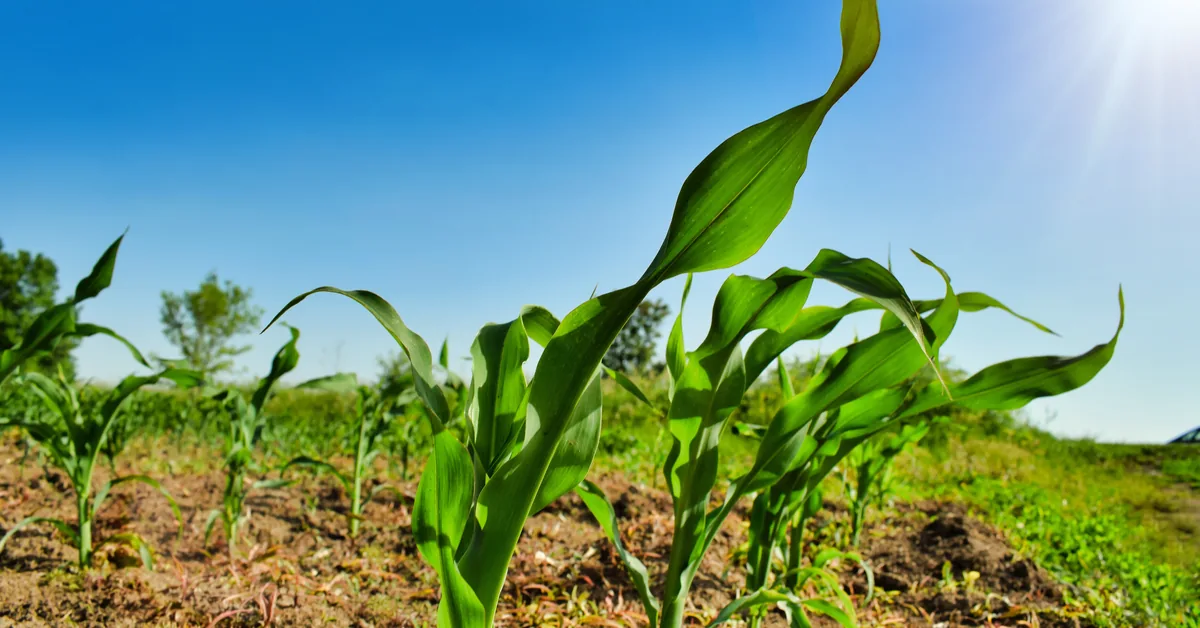
Corn represents a good example of an extensive crop subject to strong heat stress during summer. Therefore, well calibrated potassium nutrition proves especially decisive for this species.
In greenhouse horticultural crops, ventilation combined with foliar biostimulants improves tolerance to heat stress. Therefore, both factors must be planned jointly.
In woody crops, precision irrigation together with long term nutrition programs strengthens the tree’s structure. This combination improves resistance to repeated extreme events.
Likewise, each type of crop requires a specific adjustment of doses and application schedule. Therefore, there is no single recipe valid for every case.
In cut flower and ornamental crops, the greenhouse’s thermal stability directly conditions final quality. However, a well adjusted nutritional program compensates for part of that environmental variability.
On the other hand, in rainfed farming areas, stubble management and cover crops make the difference between campaigns. This practice conserves residual soil moisture during the most critical months.
Common mistakes when planning climate adaptation
Many farmers act only when stress is already evident. However, prevention always proves more effective and economical than correction.
On the other hand, applying generic solutions without prior diagnosis usually generates irregular results. As a result, each operation needs a plan adapted to its specific context.
Likewise, ignoring soil biology while optimizing only foliar nutrition limits results. Both levels must be worked on jointly and in a coordinated manner.
Furthermore, underestimating the role of adapted genetics reduces room for maneuver against extreme events. This variable deserves the same attention as nutrition or irrigation.
As a result, the most frequent mistake consists of treating each strategy in isolation. Only the coordinated combination of all of them offers consistent results.
Likewise, postponing technical training for the field team limits the correct execution of any plan. Therefore, investing in training proves as important as investing in inputs.
Conclusion: towards agriculture prepared for the future
Climate resilience does not depend on a single magic solution. However, it arises from the intelligent combination of genetics, technology, soil and nutrition.
Farmers who integrate these strategies in a coordinated way obtain more stable and productive crops. Therefore, advance planning becomes the best tool available.
Furthermore, advanced nutrition acts as the transversal axis that connects all the other strategies. This integrated vision will shape agriculture in the coming decades.
From Agrovisión, magazine of agricultural innovation by Excellent Nutrients, we will continue exploring how technology, science and innovation are redefining the future of modern agriculture.