
Cannabis Vanguard — innovation & science by Excellent Nutrients
Water in Cannabis Indoor: The Parameter That Generates the Most Errors in Professional Production
Water management in cannabis indoor is the production factor that generates the most errors in professional cultivation. However, it is also the easiest to optimise when the physiology behind it is understood.
In indoor cultivation, the grower has complete control over the water supply. There is no rain, no capillarity from water tables, no external climate variability. Therefore, every drop of water the plant receives is a decision made by the grower.
This total responsibility is an enormous advantage. However, it is also a source of frequent errors. Overwatering is the most common problem in indoor cannabis. Furthermore, water deficit at critical moments of the cycle can irreversibly reduce yield and quality.
Therefore, managing water with precision is not optional in professional production. It is the foundation on which any efficient nutritional programme is built.
Root Physiology in Cannabis: How the Plant Absorbs Water
Cannabis roots absorb water mainly through root hairs. These are microscopic structures that enormously increase the absorption surface. Therefore, root health is the first factor that determines the water efficiency of the plant.
Absorption occurs by osmosis. This happens when the concentration of solutes in the root cell is greater than in the substrate solution. Therefore, the electrical conductivity of the nutrient solution has a direct impact on water absorption.
An EC that is too high generates osmotic stress. The plant cannot absorb water even when the substrate is moist. This phenomenon is called physiological drought. However, it is completely avoidable with adequate EC control.
Furthermore, the temperature of the nutrient solution directly affects root absorption. Below 18°C root activity is significantly reduced. Above 26°C dissolved oxygen in the water decreases and favours the development of root pathogens such as Pythium.
Substrates in Cannabis: Water Retention Capacity and Root Oxygen Management
The substrate is the medium where the roots live. Therefore, its physical properties directly determine the water management of the crop. In professional cannabis, the most commonly used substrates are coconut fibre, rockwool, perlite and peat mixes.
Coconut fibre is the most popular substrate in professional cannabis. It has a water retention capacity of 70 to 80% and an air porosity of 20 to 30%. However, its buffering effect on calcium and magnesium must be considered in the nutritional programme.
Rockwool is the reference substrate in high-production hydroponic systems. It has very high water retention and excellent air porosity when managed correctly. However, it requires very precise irrigation scheduling. Furthermore, it is an inert substrate that contributes no nutrients by itself.
Perlite is used mainly as a component of mixes to improve drainage and root aeration. Its water retention is low, between 30 and 40%. However, its air porosity is very high. Therefore, it is ideal for mixing with high-retention substrates such as coco.
Peat mixes are organic substrates with high water retention and good biological activity. However, their acidic pH requires correction. Furthermore, their variability between batches can generate inconsistencies in the irrigation programme.
Irrigation Scheduling in Cannabis: Frequency, Volume and Optimal Timing
Irrigation scheduling is the most important technical skill in professional cannabis cultivation. However, many growers base it on fixed routines rather than the real needs of the plant.
The objective is to keep the substrate in the optimal moisture zone, moist enough to guarantee root absorption but with sufficient air to oxygenate the roots. Therefore, both excess and deficit are problematic.
Irrigation frequency depends on the substrate, plant size, temperature, humidity and cycle phase. In general, coco requires more frequent irrigation than peat. Furthermore, plants in full flowering consume more water than in vegetative. Therefore, frequency must be continuously adjusted throughout the cycle.
The optimal irrigation volume generates a runoff of 10 to 20% of the applied volume. This runoff is necessary to prevent salt accumulation in the substrate. However, excessive runoff represents a waste of water and nutrients.
The first irrigation of the day should be carried out 1 to 2 hours after the lights come on. At that moment the plant has consumed the water accumulated overnight and is ready to absorb actively. Furthermore, irrigating right at light-on can saturate the substrate when root activity is minimal.
The last irrigation should be carried out 1 to 2 hours before the lights go off. This allows the substrate to drain excess water before the dark period. Therefore, the roots have access to oxygen during the night, which favours their development.
To optimise crop performance, it is essential to apply advanced plant nutrition strategies that complement the irrigation programme at each phase of the cycle.
Precision Fertigation in Cannabis: EC, pH and Nutrient Solution Composition
Fertigation is the most efficient nutritional application method in professional cannabis. Water acts as a vehicle to distribute dissolved nutrients directly to the root zone. Therefore, the efficiency of both water and nutrients increases simultaneously.
Electrical conductivity indicates the total concentration of dissolved salts in the nutrient solution. It is expressed in mS/cm. Optimal ranges vary according to the cycle phase. During the vegetative stage the range is 1.2 to 1.8 mS/cm. During early flowering it rises to 1.8 to 2.2 mS/cm. At full flowering the optimal range is 2.0 to 2.6 mS/cm. During the final weeks it is progressively reduced to 0.8 to 1.2 mS/cm.
pH determines the availability of each nutrient to the plant. The optimal range in cannabis is 5.8 to 6.2 in inert substrates such as coco and rockwool. In organic substrates the range rises slightly to 6.0 to 6.5. Outside these ranges, some nutrients precipitate and become inaccessible. Therefore, pH control is as important as nutritional composition.
Nutritional needs vary significantly throughout the cycle. During the vegetative stage, nitrogen demand predominates. At flowering, phosphorus and potassium demand increases. Furthermore, calcium and magnesium are critical nutrients in all phases. Therefore, the nutritional programme must be adjusted week by week.
Water Management in Flowering: Substrate Flushing and Final Maturation
Water management in the final weeks of flowering has a direct impact on the quality of the final product. Therefore, it deserves special attention within the irrigation programme.
Substrate flushing consists of applying water without nutrients during the last 7 to 14 days before harvest. The objective is to eliminate excess accumulated salts and favour the mobilisation of the plant’s nutritional reserves towards the inflorescences.
However, excessive flushing can generate premature nutritional deficiencies. Therefore, the start time and duration must be calibrated according to the variety and cultivation conditions.
Furthermore, the progressive reduction of EC during the final weeks favours the accumulation of sugars and aromatic compounds in the inflorescences. Therefore, final water management is also a quality tool, not just a substrate cleaning measure.
The reduction of relative humidity below 40%, combined with adjusted water management, generates a controlled stress that stimulates resin production as the plant’s defensive response. Therefore, climate and hydration must be managed in a coordinated manner in the final phase of the cycle.
Irrigation Automation: Controllers and Sensors in Professional Production
Irrigation automation is essential in continuous production facilities. However, it is also accessible to medium-scale growers thanks to the reduction in costs of currently available control systems.
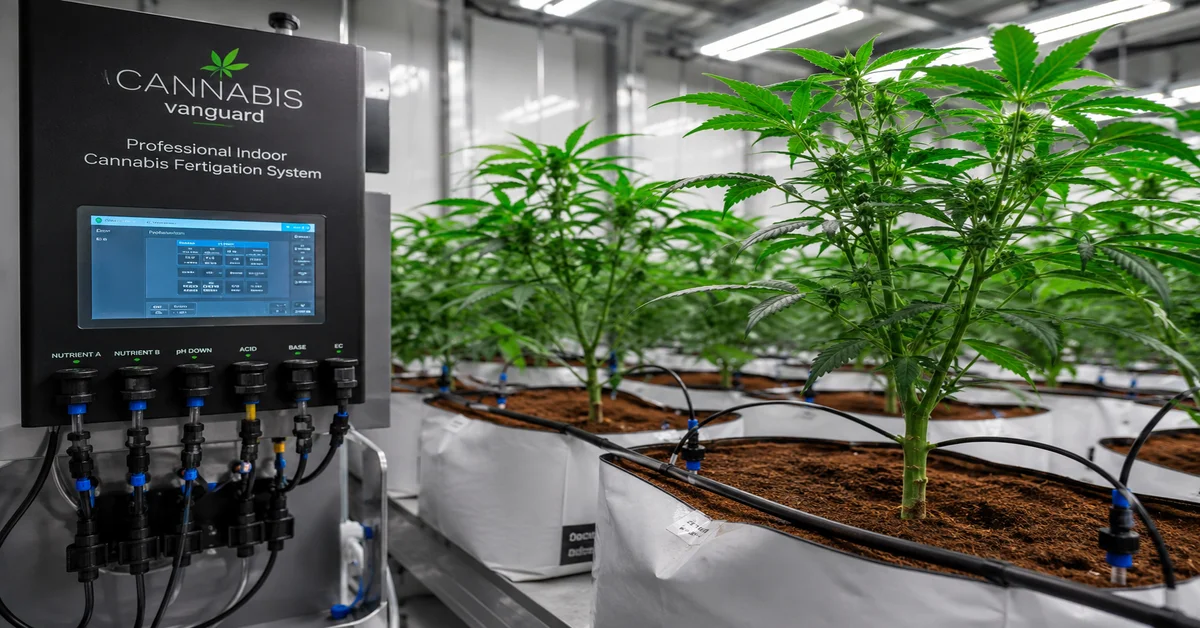
Automated irrigation combines programmable controllers that define frequency, duration and volume of each irrigation event. Furthermore, it incorporates substrate moisture sensors that activate irrigation based on real water content, not a fixed schedule. Therefore, the system adapts automatically to the changing conditions of the crop.
The most advanced models incorporate inline EC and pH meters that monitor the nutrient solution in real time. When any parameter deviates from the programmed range, the system automatically adjusts the dosage. Thus, the nutrient solution always remains within optimal parameters without manual intervention.
The integration of the irrigation system with the climate controller allows coordination of irrigation events with lighting cycles and environmental parameters. Consequently, the cultivation system functions as an integrated organism where each variable adjusts according to the others.
Advanced Nutrition in Cannabis: The Connection Between Water and Fertilisation
Water management and plant nutrition are two inseparable systems in professional cannabis cultivation. However, many growers manage them independently, without considering the profound interdependence that exists between them.
Nutrition is not independent from hydration. Every chemical and biological reaction that determines the availability of each nutritional element occurs within the water medium. Consequently, any alteration in water management directly affects the nutrition of the plant.
A clear example is the effect of overwatering on root oxygenation. When the substrate is permanently saturated, the roots do not have access to the oxygen needed to actively absorb nutrients. Furthermore, anaerobic conditions favour the development of pathogens such as Pythium and Fusarium. The result is a simultaneous problem of water stress, nutritional deficiencies and health issues.
By contrast, water deficit reduces the transpiration stream and with it the transport of calcium and magnesium to aerial tissues. Likewise, it concentrates salts in the substrate solution, raising electrical conductivity above the optimal range. Even moderate water deficit can generate symptoms of salt toxicity in well-fertilised plants.
Optimising the Nutritional Programme According to the Water Phase
Integrating the nutritional programme with the irrigation programme allows the design of much more precise and efficient fertilisation strategies. The best professional growers do not design these two programmes separately but as a single integrated system.
During phases of higher water demand, such as full flowering, irrigation frequency increases. Furthermore, the volume of each event must be adjusted to maintain the target runoff of 10 to 20%. In this case, the nutrient concentration in the solution must be recalculated to ensure the plant receives the correct dose.
During phases of lower water demand, such as the rooting period and the final weeks of maturation, irrigation frequency decreases. However, the concentration of the nutrient solution must be adjusted proportionally. The nutritional programme is therefore a dynamic system that evolves in parallel with the irrigation programme throughout the entire cultivation cycle.
Integrated Management as a Competitive Advantage in Professional Production
Growers who integrate water and nutrition as a single system obtain significantly superior results. Furthermore, this integration allows fertiliser consumption to be reduced by 15 to 25% without compromising yield, simply by optimising the timing and concentration of each application.
The digitalisation of both programmes in a single management platform is the next step in the evolution of professional cannabis cultivation. Currently there are systems that simultaneously monitor substrate moisture, EC and pH, and automatically adjust both irrigation volume and nutrient dosage. Therefore, integrated water and nutrition management is not only an agronomic strategy but also a real competitive advantage in a market that demands ever greater consistency and quality.
Water Management Cannabis: From Cultivation to Post-Harvest Quality
The relationship between water management in cannabis and final product quality extends beyond the cultivation cycle itself. Furthermore, it directly influences the post-harvest phase. Plants managed with precise water protocols enter the drying process in better physiological condition. Moreover, their trichomes are more developed and their aromatic compounds are better preserved.
The drying environment must be considered a direct continuation of the water management strategy applied during cultivation. Therefore, the transition from the grow room to the drying room must be gradual and deliberate. Abrupt changes in humidity during this transition can cause irreversible damage to the terpene profile.
Furthermore, growers who document their water management cannabis data systematically build a valuable knowledge base. This allows them to identify correlations between irrigation parameters and final quality metrics. Moreover, this documentation is increasingly required by regulatory bodies in markets where medical and adult-use cannabis is legally produced. Therefore, precise water management is not only a cultivation tool but also a commercial asset that differentiates professional producers in a competitive global market. This level of precision represents the new standard of professional cannabis production worldwide.
Producers who consistently apply integrated water management protocols report not only superior analytical profiles but also significantly lower production costs per gram. Moreover, they build a reputation for reliability that opens doors to premium markets and long-term commercial partnerships.
From Cannabis Vanguard — innovation & science by Excellent Nutrients, we will continue exploring how technology, science and innovation are redefining cannabis production and quality in a rapidly evolving industry.