
Agrovisión — magazine of agricultural innovation by Excellent Nutrients
Water in Agriculture: The Most Critical and Most Wasted Resource on the Planet
Water is the most limiting resource in global agricultural production. However, conventional agriculture wastes between 40 and 60% of the water it consumes. This happens due to inadequate irrigation systems, poor scheduling and lack of knowledge about plant water physiology.
In the current context, this situation is unsustainable. Climate projections indicate that water stress will affect 40% of the world’s agricultural surface before 2050. Furthermore, competition for water between the agricultural, industrial and urban sectors increases every year.
Therefore, water efficiency is not just an environmental issue. It is an urgent economic and productive necessity for any farm aspiring to be competitive in the coming decades.
However, improving water efficiency does not simply mean irrigating less. It means irrigating better, with the right amount, at the right time and in the right place. Moreover, this requires understanding how water works inside the plant and how plant physiology responds to water deficits and excesses.
Plant Water Physiology: How the Plant Absorbs and Transports Water
Water enters the plant mainly through root hairs. From there it rises through the xylem to the leaves. This process is called the transpiration stream. Furthermore, it is driven by the difference in water potential between the soil, root and atmosphere.
Transpiration is the engine of this flow. When stomata open to capture CO2, water vapour exits the leaf into the atmosphere. This water loss generates a tension that pulls water upwards from the roots. Therefore, transpiration and root absorption are directly coupled processes.
This mechanism has very important agronomic implications. In the first place, the flow of nutrients dissolved in water follows the same path as the water. Therefore, when transpiration is reduced, nutrient absorption is also reduced. Moreover, this explains why plants under water stress show symptoms of nutritional deficiency even when the soil has available nutrients.
Furthermore, the opening and closing of stomata simultaneously regulates both CO2 entry and water vapour exit. Therefore, any factor affecting the stomata affects both photosynthesis and transpiration. In addition, temperature, humidity, light and the plant’s water status continuously modulate this balance.
Water Stress: Types, Physiological Thresholds and Productive Consequences
Water stress occurs when the plant’s water demand exceeds the available supply from the soil. However, not all water stress is negative. There is a moderate and controlled water stress that can improve the quality of the final product. By contrast, severe stress reduces yield irreversibly.
Mild water stress occurs when leaf water potential falls between -0.5 and -1.2 MPa. The plant partially closes its stomata. Photosynthesis is moderately reduced. However, the plant activates adaptation mechanisms including the synthesis of proline and other osmolytes that protect cell membranes. Furthermore, it stimulates deep root growth in search of water.
Moderate water stress occurs when leaf water potential falls between -1.2 and -2.0 MPa. Stomatal closure is more pronounced. Photosynthesis is significantly reduced. Moreover, ethylene synthesis increases, accelerating leaf senescence and potentially causing abscission of leaves and fruit.
Severe water stress occurs when leaf water potential falls below -2.0 MPa. Cell membranes are irreversibly damaged. Photosynthesis ceases. Therefore, yield is permanently reduced and subsequent recovery is slow and incomplete.
The threshold between moderate and severe stress varies between species and varieties. Furthermore, the plant’s previous water history influences its tolerance. Plants subjected to cycles of mild stress and recovery develop greater tolerance to subsequent stress. However, plants that have never experienced water deficit are much more sensitive to sudden drought episodes.
To optimise these processes, it is essential to apply advanced plant nutrition strategies from excellentnutrients.com.
Irrigation Systems: Comparative Efficiency and Selection Criteria
The choice of irrigation system is the decision with the greatest impact on the water efficiency of a farm. However, different systems have very different profiles of efficiency, cost and suitability for each crop type.
Surface irrigation is the oldest and least efficient system. Application efficiency is 40 to 60%. Much of the water is lost through surface runoff and deep percolation. Furthermore, it promotes soil compaction and weed proliferation. However, its installation cost is very low. Therefore, it remains predominant in extensive crops in areas with abundant and cheap water.
Sprinkler irrigation improves application efficiency to 70 or 80%. It is suitable for extensive crops such as cereals, grasslands and some vegetables. However, it has important limitations. In windy conditions, evaporation losses increase significantly. Moreover, it wets the foliage, which can favour fungal diseases in sensitive crops.
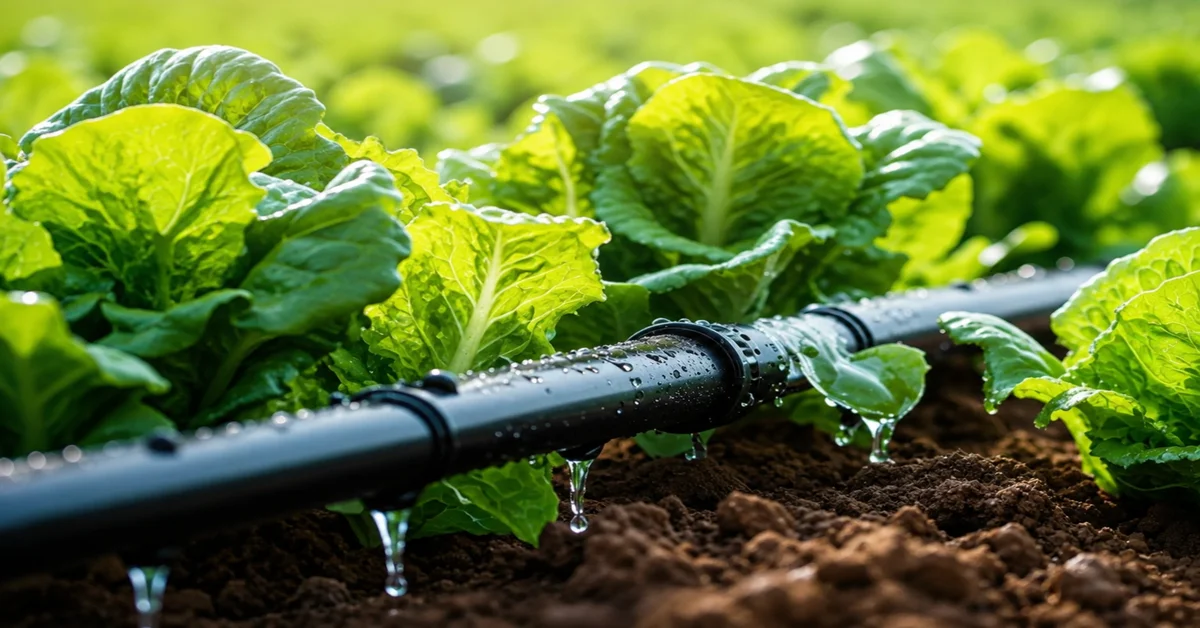
Drip irrigation is the system with the highest application efficiency, between 90 and 95%. Water is applied directly to the root zone. Therefore, evaporation and runoff losses are minimal. Furthermore, it allows fertigation, the simultaneous application of water and dissolved nutrients. In addition, this significantly improves nutritional efficiency and reduces fertilisation costs.
Subsurface irrigation efficiency can exceed 95%. Emitters are installed below the soil surface, directly in the root zone. Moreover, it eliminates surface evaporation and reduces weed proliferation. However, its installation cost is high and maintenance is more complex.
Irrigation Scheduling: Evapotranspiration, Sensors and Predictive Models
Irrigation scheduling is as important as the chosen irrigation system. However, a poorly scheduled drip system can be as inefficient as a well-managed surface irrigation system. Therefore, data-based scheduling is the differentiating element of modern water efficiency.
Reference evapotranspiration, known as ET0, is the amount of water evapotranspired by a reference crop under standard conditions. It is calculated using the Penman-Monteith equation from climate data, including temperature, humidity, wind speed and solar radiation. Furthermore, it is multiplied by the crop coefficient, known as Kc, to obtain the actual evapotranspiration of each crop at each development stage.
Soil moisture sensors, including tensiometer, TDR and FDR models, allow real-time monitoring of soil water content. This allows irrigation to be scheduled according to the actual needs of the crop. Moreover, it avoids both water deficit and excess. Furthermore, sensors installed at different depths allow monitoring of the soil moisture profile and adjustment of irrigation duration and frequency with great precision.
Precision agriculture platforms integrate climate data, sensor data and crop simulation models to generate automated irrigation recommendations. Moreover, some platforms incorporate satellite or drone imagery to detect areas with water stress before they are visible to the naked eye. Therefore, they allow preventive intervention before yield is affected.
Precision Fertigation: Integrating Water and Plant Nutrition
Fertigation is the technique that integrates irrigation and fertilisation in a single process. Water acts as a vehicle to distribute dissolved nutrients directly to the root zone. Therefore, the efficiency of both water and nutrients increases simultaneously.
However, not all fertilisers are compatible with fertigation. Fertilisers for fertigation must have high water solubility, low relative salinity and absence of elements that could precipitate in pipes or emitters. Furthermore, compatibility between different fertilisers must be checked before mixing them in the tank.
Fertigation scheduling must consider the phenological stage of the crop. Nutritional needs vary significantly throughout the cycle. Therefore, the most efficient fertigation programmes adjust both the dose and the composition of the nutrient solution at each stage of development.
Moreover, the electrical conductivity and pH of the nutrient solution must be continuously monitored. Excessive electrical conductivity can generate osmotic stress in the roots. Furthermore, inadequate pH can precipitate nutrients and make them inaccessible to the plant. Therefore, control of these two parameters is essential in any precision fertigation system.
Water Efficiency and Climate Change: Agronomic Adaptation for a Future with Less Water
Climate change is reducing water availability for agriculture in the main producing zones of the world. Rainfall is more irregular. Drought periods are more frequent and prolonged. Furthermore, rising temperatures increase evapotranspiration and reduce the efficiency of conventional irrigation.
In this context, agronomic adaptation is urgent. However, solutions exist and are within reach of any farm that decides to implement them systematically.
The selection of water stress-tolerant varieties is the first line of adaptation. Furthermore, varieties with deeper root systems, greater water use efficiency and recovery capacity after drought episodes offer a significant competitive advantage under water scarcity conditions.
Conservation agriculture, with minimum tillage and cover crops, reduces surface evaporation and improves rainwater infiltration. Moreover, it increases the organic matter content of the soil, improving its water retention capacity. Therefore, each percentage point of organic carbon gained in the soil equals greater water reserve available for the crop.
The reuse of treated wastewater and rainwater harvesting are complementary strategies gaining relevance in areas with chronic water scarcity. Furthermore, controlled deficit irrigation systems, which deliberately apply a moderate water deficit during non-critical crop phases, allow water consumption to be reduced by 20 to 40% without significant yield losses.
Precision Agriculture and Digital Tools for Water Management
Precision agriculture is transforming water management in professional farming. Today, digital tools allow farmers to monitor, analyse and optimise water use with unprecedented accuracy. Furthermore, these technologies are becoming increasingly accessible to farms of all sizes.
Satellite imagery platforms such as Sentinel-2 and Landsat allow detection of water stress across entire fields before visible symptoms appear on the plants. Moreover, vegetation indices such as NDWI and NDVI provide real-time information about the water status of crops. Therefore, farmers can intervene precisely where and when it is needed.
Variable rate irrigation systems allow the application of different water doses across different zones of the same field. This is especially useful in fields with heterogeneous soils. Furthermore, when combined with soil moisture sensor networks, these systems can reduce water consumption by an additional 15 to 25% compared to conventional drip irrigation.
Artificial intelligence is also entering water management. Machine learning algorithms analyse historical climate data, soil sensor readings and satellite imagery simultaneously. As a result, they generate irrigation recommendations that continuously improve with each crop cycle. Moreover, some platforms can predict water stress episodes up to 72 hours in advance, allowing preventive action before yield is affected.
Water, Soil and Nutrition: An Integrated Agronomic Vision
Water management in agriculture is also closely linked to soil health. A soil rich in organic matter retains significantly more water than a degraded soil. Furthermore, the presence of an active and diverse soil microbiome improves the soil’s physical structure, increasing its porosity and water infiltration capacity. Therefore, the strategies explored in previous editions of Agrovisión, particularly those related to soil organic carbon and soil biology, are directly connected to water efficiency.
This systemic vision is essential. Water efficiency cannot be addressed in isolation from soil management, plant nutrition and crop variety selection. Moreover, the most effective results are always achieved when these dimensions are managed together as part of an integrated agronomic programme.
The economic dimension of water efficiency is also increasingly relevant in regulatory terms. The European Union’s Water Framework Directive and the new CAP regulations are progressively tightening requirements for water use in agriculture. Furthermore, farms that demonstrate measurable improvements in water use efficiency will have preferential access to subsidies and rural development funds in the coming years. Therefore, investing in precision irrigation and digital water management tools is not only agronomically sound but also strategically aligned with the regulatory direction of European agriculture.
The Future of Water Management: Technology, Biology and Precision
The integration of all these tools within a single farm management platform represents the most advanced model of water efficiency currently available. Furthermore, the data generated by these systems has value beyond the immediate season. It builds a historical record that allows progressive optimisation of the water management strategy year after year.
The combination of reduced water consumption, lower energy costs and improved yields generates a return on investment that typically pays back within two to three seasons. Consequently, investing in digital water management tools is today one of the most profitable decisions a professional farmer can make.
Beyond the economic dimension, digital water management also has a significant environmental impact. Moreover, every litre of water saved in agriculture is a litre that remains available for natural ecosystems, urban consumption and industrial use. Therefore, improving agricultural water efficiency is not only a competitive advantage but also a social and environmental responsibility.
The future of agricultural water management will be defined by the integration of biological knowledge, digital technology and agronomic precision. Furthermore, farmers who master these three dimensions simultaneously will be best positioned to face the water challenges of the coming decades. In addition, they will be the ones who build the most resilient and productive farming systems in a world where water is becoming the most valuable resource of all.
From Agrovisión, magazine of agricultural innovation by Excellent Nutrients, we will continue exploring how technology, science and innovation are redefining the future of modern agriculture.